
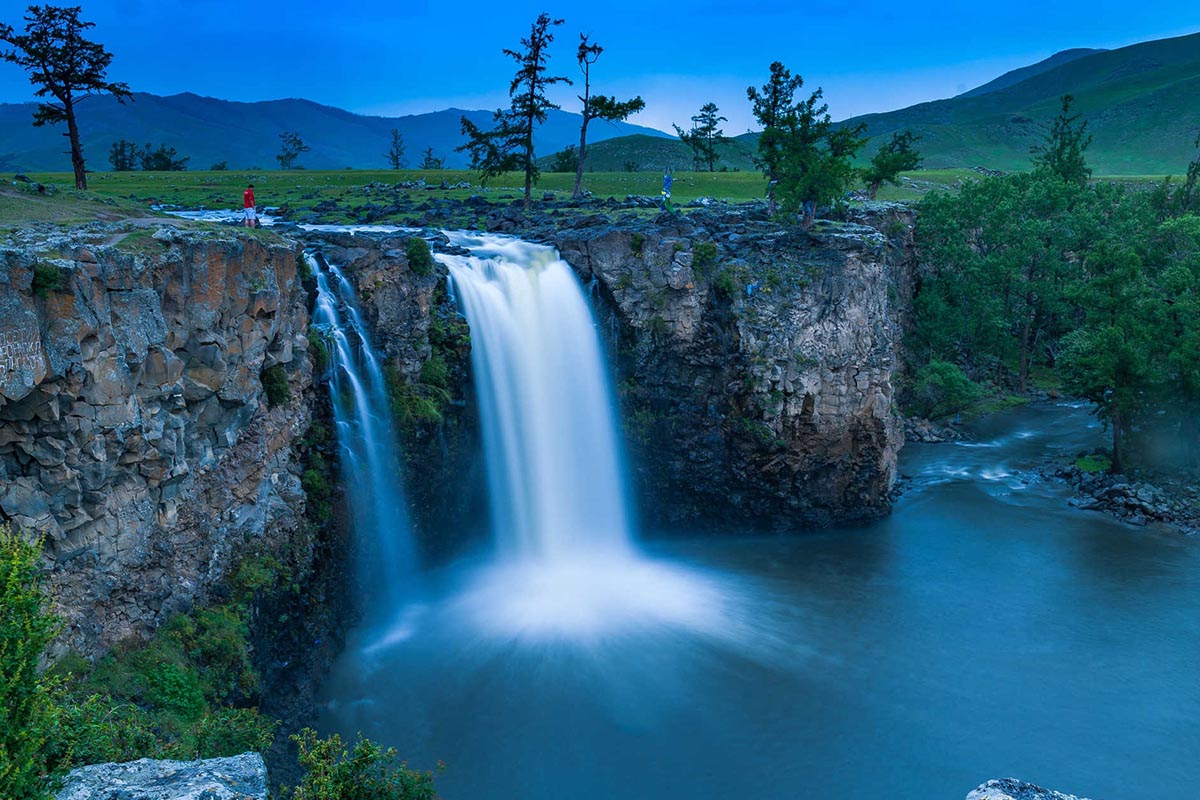
The Orkhon Waterfall, locally known as Ulaan Tsutgalan (meaning “Red Confluence”), is one of the most iconic natural landmarks in Mongolia. Located in the heart of the Orkhon Valley, a UNESCO World Heritage site, it offers a stunning contrast of white water against black volcanic rock.
1. Key Facts
- Dimensions: The waterfall is approximately 20 to 25 meters high and about 10 meters wide.
- Origin: It was formed roughly 20,000 years ago due to a combination of volcanic eruptions and earthquakes. The Orkhon River flows over a basalt layer created by ancient lava flows.
- The Name: It is called Ulaan Tsutgalan because the waterfall is formed by the Ulaan River (Red River) as it cascades into the larger Orkhon River.
2. Best Time to Visit
The waterfall’s appearance changes dramatically with the seasons:
- Peak Flow (August): Late summer is the best time to see the waterfall at its most powerful after the summer rains.
- Dry Season (Spring): During dry spells in late spring, the waterfall can occasionally slow to a trickle or dry up entirely.
- Winter (December – March): The waterfall freezes into a massive, shimmering ice sculpture, making it a unique spot for winter photography and ice climbing.
3. Activities and Surroundings
The area is more than just a photo op; it’s a hub for experiencing nomadic Mongolian culture:
- Horse Riding: The valley is the traditional “cradle” of nomadic life. Most visitors reach the falls via horse treks through the lush steppes.
- Ger Stays: You can stay with local nomadic families in traditional gers (yurts) nearby, offering a chance to try authentic yak milk products and airag (fermented mare’s milk).
- Hiking & Bird Watching: The surrounding volcanic cliffs and meadows are home to diverse birdlife, including bar-headed geese and whooper swans.
4. Nearby Attractions
Since the waterfall is a long drive (roughly 360 km) from the capital, Ulaanbaatar, most travelers combine it with other historical sites in the Orkhon Valley:
- Karakorum: The 13th-century capital of the Mongol Empire.
- Erdene Zuu Monastery: The oldest surviving Buddhist monastery in Mongolia.
- Tuvkhun Hermitage: A serene mountain monastery founded by Zanabazar, located high on a cliff overlooking the valley.
0 Comment